Dog Wheelchair Comparisons
How to choose a wheelchair?
I've been doing a lot of research lately on carts since realizing I will be needing one for another dog soon. Buying a wheelchair is a very personal decision and should be based on the needs of you and your dog. Each cart has advantages in wheelbase width, comfort, stability and ability to cross difficult terrain. Wheelchair manufacturers obviously say their own products are the best. Vets who are used to working with one particular product may well recommend that one product mainly because they have experience with it, not because it's the best choice for your dog.
Carts vary greatly even though they may look similar. For example, some have soft saddles, others rigid rings, some are collapsible, others not; some are suited for hind limb problems while some support the entire dog such as a quad cart. Some come with special modifications and accessories such as saddles for missing limbs, skis for winter and all-terrain wheels. Soft saddles would be more comfortable in general to a dog with some mobililty, however rigid ones would give more pelvic support with less trauma to soft tissue in a totally paralyzed dog.
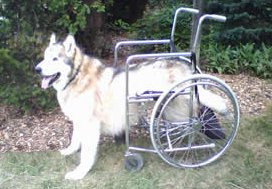
Finding the right dog cart can give your dog added strength and energy, uplifting his mood and allow him to do some of the things he loves. Whether you convert an old human wheelchair (for a big dog) or purchase a ready-made one, you'll feel good giving your handicapped dog mobility.
There are many kinds of carts - some are adjustable, while others are custom made for your dog. It pays to do a little research first before purchasing so that you find one that works for your dog. Ideally, your home will not have stairs or it will limit the amount of use your dog will get from a wheelchair. Some dogs only use them outdoors. Here is a wishlist for a cart - none have all of these qualities, but some come close.
- Broad wheels are better for outside, as they don't get stuck as easily.
- Adjustability so that you can use it for another dog if necessary
- Folds for easy storage
- Padded or fleece lined straps for comfort
- Ability to pee and poop while in the cart.
- Wheels/mechanism that allows the dog to turn easily
- Stirrups for keeping unused feet from dragging on the ground
- Washable materials that are easy to remove
- Sturdy build
- Easy in/out (velcro or other fastener) a few carts allow you to walk the dog into it by holding up his rear. Some carts you must lift the dog into and this is more difficult (especially with large dogs).
- Easy to put together and set up
- Lightweight construction - but sturdy
If the dog can use her hind legs, but can't support weight a Doggon cart with its soft neoprene saddle works well as it allows the dog to move it's legs normally as they walk. The rigid saddle on an Eddie's Wheels or K9-Kart can be too constrictive and limiting. However, if the dog is totally paralyzed in the rear, with no movement whatsoever, a rigid saddle may be better because it supports the pelvis without putting undue strain on soft tissue. In that case, it's more important how easy you can get him in and out of the cart.
Wheels are very important. You want something lightweight, larger, with good flexibility and deep tred. A smaller tire will get stuck easier but a bigger tire is difficult to maneuver. The problem I had with the home-made model is the small wheels would get stuck sideways and make it difficult to pull on grass. Also a PVC cart is just not structurally strong enough for a large dog. The narrowness of human wheelchair tires make them unsuitable for rough terrain, but a PVC cart needs to be compact or it could collapse from the weight of the dog. Ideally the tire will slant outward giving better stability in any chair you buy or build.
Another feature important to dog wheelchairs is the abiltiy to upgrade. Look for one that has special attachments such as foot slings, a quad add on, ski attachment for winter and most importantly, extra parts in case something breaks.
Conditions that can benefit from a doggy wheelchair or cart:
- Osteoarthritis
- Hip dysplasia
- Muscle injuries
- Back injuries
- Spinal injuries/intervertebral disk disease
- Fractures
- Cruciate (ACL) injury
- Amputation
- Shoulder OCD
- Elbow dysplasia
- Joint dislocation
- Patellar luxation (knee cap dislocation)
- Spondylosis
- Arthrodesis (joint fusion surgery)
- Joint replacements
- Tendon injury (e.g. biceps)
- Peripheral nerve injury
- Neuromuscular disease
- Fibrocartilagenous embolism (FCE)
- Degenerative myelopathy (DM)
- Cauda Equina Syndrome (Lumbosacral Disease)
- Balance disorders
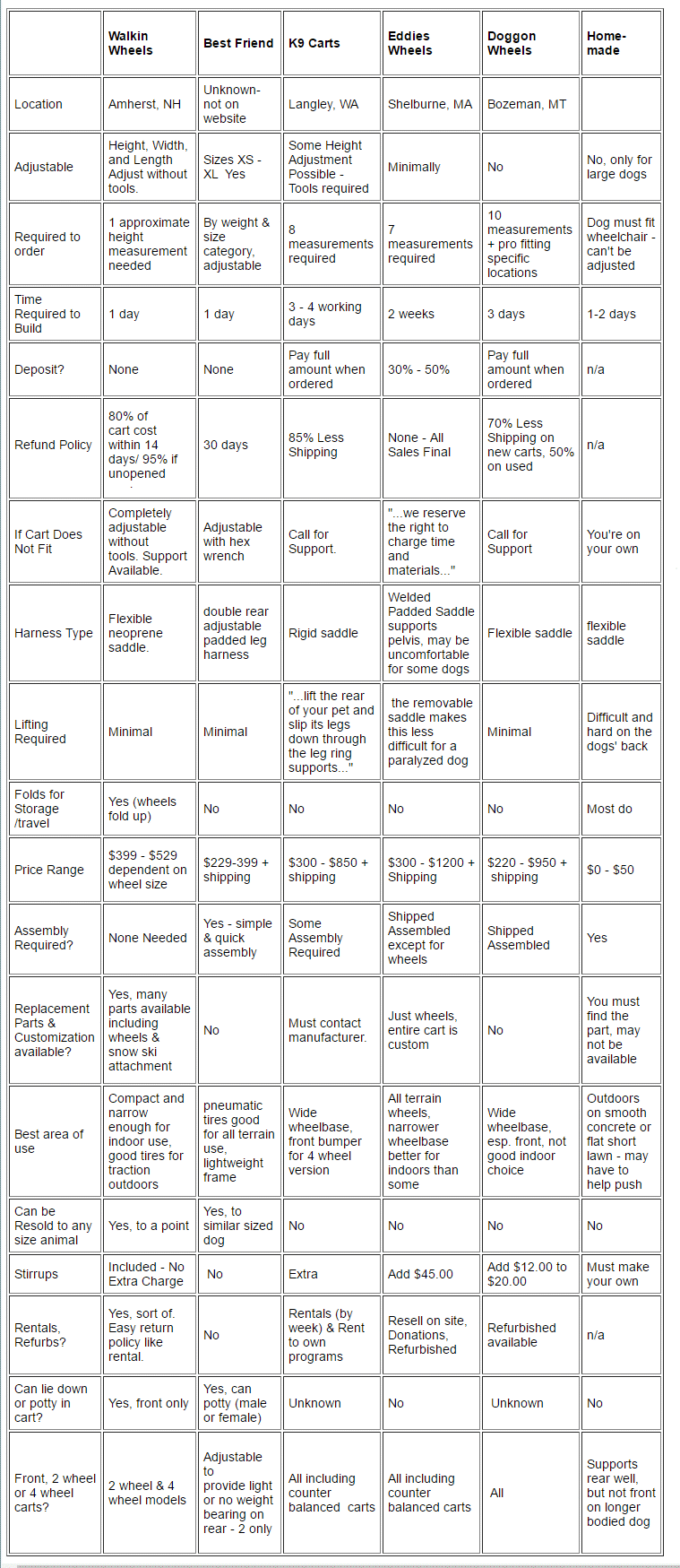
Wheelchair Comparison Chart
This chart compares the top chairs on the market. You'll want someone that will stand behind their product and help you with fitting it properly as fit is a strong factor in whether your dog will enjoy using the cart, or will just get frustrated. The more custom the cart the lower the resale value because it is not adjustable. This could be a problem if your dog is young, tends to gain weight, or you might want to sell it at some future time.
One consideration is whether the cart is "top heavy" and has a narrow wheelbase A cart that tips over can traumatize the dog and make him unwilling to use it. Look to where the dog's center of gravity will be and how wide the wheelbase is when considering your options. Consider whether you plan to use the cart indoors or out. A wider wheel base may be more stable outdoors, but can be difficult to maneuver indoors. A majority of the dogs tend to use the carts outdoors only for this reason. Also, some carts come with optional all-terrain wheels. If you walk anywhere except the sidewalk, these may be worth paying extra for. I used a human wheelchair (adapted for a dog) for Hoover and discovered the narrow wheels were difficult, if not impossible for him to use on grass and uneven terrain, but worked just fine on cement. I ended up helping push him where he wanted to go so he wouldn't get frustrated.
There are several wheelchair manufacturers including Doggon Wheels, Eddie's Wheels, Walkin Wheels, and K9 Carts. If you have a rehab center near to you, you may want to visit and ask if they have any carts that they can show you or potentially even loan you before you commit to buying a dog wheelchair. Unfortunately, most promote one kind of cart and don't give you these options - but it may be worth asking anyway. Some companies rent out carts, but it's relatively expensive to do so and is only a temporary solution since rental for a few weeks would probably equal the cost of a cart.
Ideally you are searching for a dog wheelchair that is robust and stable, able to stand up to an active dog running and playing on and off road. With carts for larger dogs costing upwards of $500 or more, it pays to do your research a head of time and before the dog is so disabled it is difficult to get him in and out of different carts or measure for them. Especially with a larger dog. One feature of the Eddie's wheels cart is an optional removable saddle. You can put the saddle on the dog while he's lying down, then use it to pick him up to fasten him in the cart. This may or may not work well for you.
Most dog carts except Walkin Wheels are custom made (and costly - especially the carts for large dogs) so you're pretty much stuck with them if you don't make the right choice and provide the exact measurements. Sometimes they can be re-fitted or re-sold, but not always. Eddie's wheels and Doggon Wheels are known for their excellent customer service but the problem with a custom cart is the difficulty of adapting it to another dog because it IS custom made.
One thing to consider is that some dogs start out pretty mobile but get progressively worse over time - such as dogs with DM - in that case you'll want a dog wheelchair that adapts to his condition without having to go out and buy a new one. You also don't want a cart that can create problems by not allowing exercise of good limbs either. Several carts have "add on" accessories that adapt to a progressively worsening condition - such as Walkin Wheels front adaptor that makes a rear cart a quad wheelchair. This is not necessary if your dog has a permanent injury that will not get worse. Counterbalanced carts are available that can assist dogs that have paralyzed rears, but also weak fronts. They take some of the weight off the front legs. This tends to keep the front legs from getting enough exercise so it's not recommended you only use this kind of cart when needed. On the other hand, you'll need a second cart if the dog's front legs get weak and you have a cart that can't be adapted for this.
Most dog wheelchairs are built and sized for one particular dog. A few are adjustable enough that they could be used for multiple dogs of similar size - some are not adjustable at all. Depending on your situation, this may or may not be important to you. An adjustable cart is much easier to sell or pass on when you no longer need it, but may not fit your current dog as well as it could. You can't expect a cart for a 30 lb. dog to be adjustable up to a 90 lb dog or visa versa. Most carts come in general sizes and adjust more specifically from there.
It's also important with some carts to order a male or female cart. The type of saddle is dependent on the sex of the dog and cannot be used for the opposite sex. For example, an Eddie's wheels cart made for a male cannot be used for a female.
Stirrups are helpful if the dog drags it's feet. Without booties or stirrups of some kind a dog that cannot use it's feet will drag them - and they will get sore and bloody. A cart that has stirrups that may or may not be used is probably the best option because you sometimes don't know if you'll need them. Other options are a band the feet are supported on. Not all dogs will leave their feet there because they have some mobility in the leg, so this doesn't always work.
Finally, with an older pet, it is important to think about what your pet likes to do. If they are content to just lay around, and only be taken out for very short periods, a handheld sling may be all you need. On the other hand, if they are bright and alert and full of life, despite a mobility problem, a pet wheelchair can give your dog a longer, happier, and healthier life. Just being able to "walk" and smell the roses did wonders for Hoover's attitude. He was a happier dog because even though he didn't use the wheelchair often, he COULD use it, and that's what mattered.
Extra Dog Wheelchair features
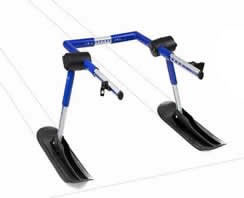
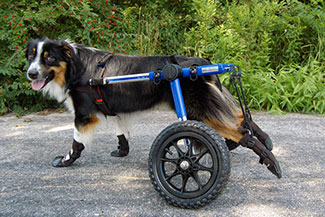
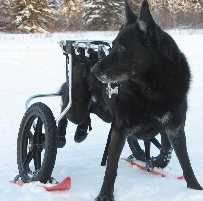
One of the reasons I like the Walkin Wheels cart is the variety of attachments available to customize it. A set of skis are available for winter carting that is absolutely wonderful if you live in the north with lots of snow like I do. They also have various foot protections and trainers such as a knuckle-under sock and a boot stirrup kit which protect the feet. Also front attachments making all sizes of wheelchair a quad chair are available. Lastly, there is an extensive parts kit available should anything break. Walkin' Wheels' customer service is extraordinary and pretty much everything on the cart can be repaired if needed - a real plus if you have a bull in a chinashop kind of dog!
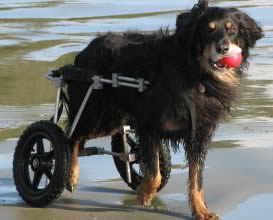
Dogs in wheelchairs playing catch.
Ricky Bobby in a drag bag gets a wheelchair!
One of the reasons I like Walkin' Wheels chairs is because they are adjustable and have various attachments to make them a quad, should the dog's front end get weak, or skis for winter or boot options to stop foot dragging.
The following attachments can be ordered with the same sized wheelchair or added later. 2-3" Caster front wheels, depending on dog size, and has comfortable front support leg rings.